


What sets RBC’s FX algo suite apart from the competition?
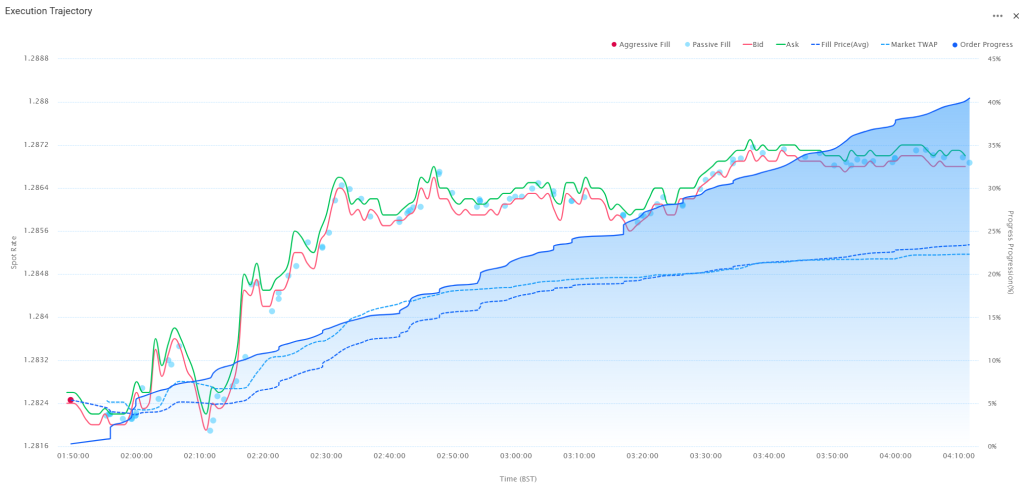
RBC algos are primarily designed to adapt to liquidity conditions in real-time which helps avoid the risk of overfitting to historical data. A key differentiator is our proprietary Limit Order Model (patent pending), which intelligently optimises order placement across the liquidity landscape to help achieve the best execution possible while maintaining a low footprint and minimising information leakage. We invest heavily in deep cross-asset R&D, combining signal intelligence with client centric customisations. Importantly, clients lean on us for thought leadership, and we build long-term partnerships built on exceptional service, trust and transparency.
Can you share any recent examples of new developments?
We are constantly investing in the product to ensure we continue to deliver optimised execution solutions in partnership with our clients. Three recent additions include:
- LAKE – Our new internal dark central limit order book, providing enhanced internalisation through intelligent order matching functionality. All internal RBC fills are differentiated and clearly identified within the RBC and 3rd party independent TCA reports.
- SPRINT – Our principal liquidity offering designed to improve execution quality via algorithmic access to differentiated, unique liquidity. It adds smart internalisation capabilities that automatically leverage principal FX liquidity when market conditions deteriorate – specifically for outsized orders or abnormal decay rates – providing protected execution quality through intelligent risk transfer.
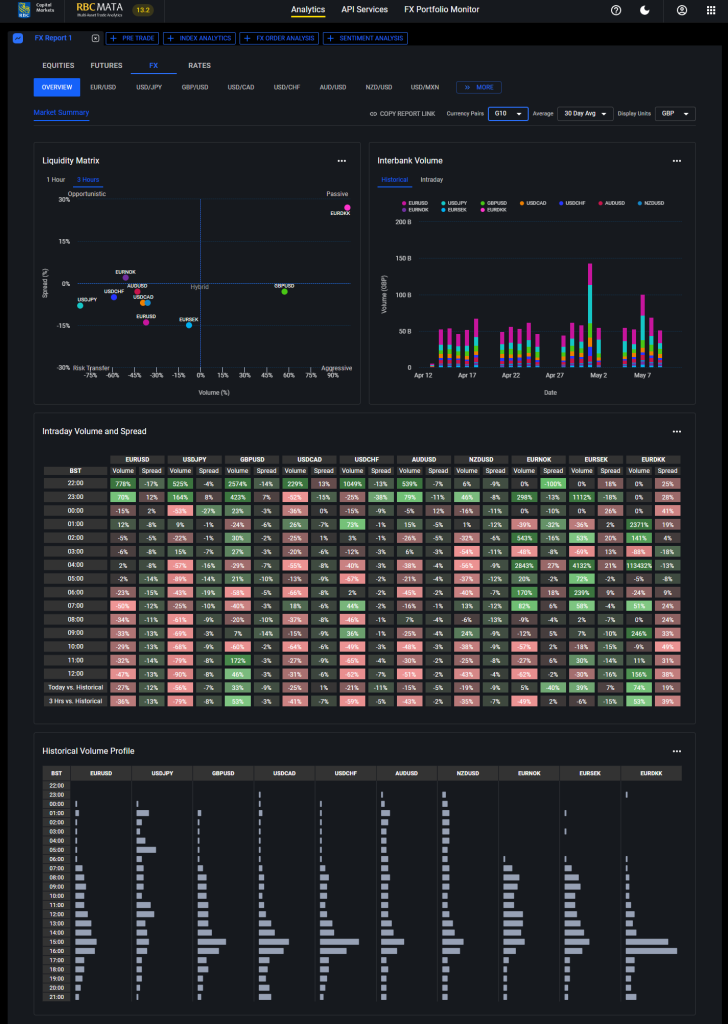
- MATA (Multi-Asset Trade Analytics) is our online interactive portal providing pre-trade and real-time in-trade analytics, including estimated algo cost/duration and real- time volume/spread data. MATA is also available via API to consume directly, and we are currently integrating MATA into the leading 3rd party platforms.
Which client segments are most likely to utilise algo execution?
We continue to see strong engagement across client types, with particularly active adoption among asset managers. Clients are now more comfortable and confident in using algos which is helping to fuel growth, but we have also directly benefited with clients leveraging independent TCA to help drive better decision making.
What are clients looking for in terms of liquidity curation?
Liquidity is critical, and there are a myriad of liquidity sources, each with its own nuances; lit markets (e.g. primary vs. secondary, full amount vs. sweepable, firm vs. last look etc), as well as dark, midpoint and internal pools.
Correctly harnessing the diverse types of liquidity at any point in time is fundamental to the success of algo execution. Our algo suite uses advanced policy iteration techniques to achieve best execution by intelligently blending multiple liquidity sources in real-time, based on evolving intraday market conditions.
Have you seen any increase in demand for internalisation and what are the drivers behind this?
Yes, we have seen increased client demand for internalisation, but internalisation can mean different things to different people, so we always advocate for clients to carry out their own due diligence with their brokers to help truly understand how internalisation works in practice. As an example, we have seen strong execution performance using properly curated external liquidity so why limit yourself to only internal liquidity.
Providers save on brokerage costs by using internal liquidity but that might not always be optimal for the end user. Clients should not focus on ‘internal’ vs ‘external’ due to the nuances across all liquidity types, but the key is having access to a blend of uniquely curated and diverse liquidity which the algo can intelligently interact with.
How have the ways in which clients utilise data and analytics evolved?
Having access to real-time pertinent information helps drive improved execution decision making in terms of the type of execution to use (e.g. algo vs risk-transfer) or type of algo strategy to use (e.g. aggressive vs passive). A pilot would not fly a plane without first understanding the weather conditions, and this is no different to a trader using an algo. The challenge is delivering the required information to the trader at the right time, which is why we developed MATA.
MATA provides a high-level market summary providing a real-time overview of the market environment with suggested execution style visually displayed by the relevant quadrant. Additionally, it provides detailed currency pair analysis, pre-trade cost model, and real-time in-trade algo TCA. MATA is available online and via API, and will soon be live on the leading 3rd party platforms.
In what ways do you support the customisation of FX algo strategies or demand for bespoke algo strategies?
There is no one-size-fits-all when it comes to algo execution due to different execution objectives and target benchmarks among clients.
By partnering with clients, we can provide tailored optimised solutions. For example, we have clients who use our intelligent hybrid IS algo strategy, but what a Hedge Fund determines as an aggressive urgency can be very different to what an Asset Manager determines as such, and therefore we have multiple variations of IS which are optimised for individual clients.
Is there any demand for AI or machine learning tools to further enhance existing algo toolsets?
Machine learning has clear potential in execution algos, and within our equities business we’re already live and leveraging deep reinforcement learning to adapt to real-time market conditions.
For FX, it must meaningfully improve execution rather than serve as a marketing feature. We use real-time probabilistic estimation to optimise venue selection which leverages a shared state model to benefit and automatically adapt every time an algo order is executing for any client or currency.
One of the biggest challenges with AI, outside of compute resource, is that regulatory compliance remains a significant hurdle, but one in which we are well placed to discuss.
What do you expect will be the direction of travel for the FX algo market looking ahead?
Investment into technology, algo execution, analytics and automation will continue unabated with intensifying technological competition. The market share of algo execution will continue to grow with focus on NDF algos, basket algos, and AI-based algos. Innovation will drive this business, and we are excited for the future.
