


The report, titled: FX Spotlight: Buy-side traders focused on best ex, algos and Non Bank Liquidity Providers (NBLPs), is based on the findings from interviews conducted with buyside FX traders in a bid to better understand their use of technology, dealer relationships and other market structure trends. Among the key trends identified is the new dominance of algo trading and technology for executing FX flows. While algos were once considered a supplementary tool, the report finds they have now become the primary method for a significant portion of daily flow, with some participants noting that algo liquidity has risen to the point where they, “now handle upwards of 90% of volume”. According to the report, the sophistication of these tools is highly valued, such as adaptive algos that react to market movements. AI, while seen as a ‘topic of curiosity’, was found to be still in the very early exploratory stages for most in terms of practical implementation. “However, the desire for more automated trading will likely fuel advances in the coming years,” says Costabile.
In addition, the study reveals that more algo adoption is coming from participants who are looking beyond ways to ‘VWAP’ lower-touch trades. “As a result, algos are attractive because they are becoming more sophisticated,” adds Costabile. “As professionals seek more efficiency and superior execution, algos are turning into adaptive systems that can intelligently work orders, slow down to capture favourable price movements, and speed up to avoid adverse selection.”
Algo sophistication and liquidity access
While not a comprehensive list of the range of algos currently available, when asked what types of algos are being used, participants did highlight a broad selection of different algo strategies and varying goals of automated execution:
- Adaptive algos: “We use J.P. Morgan’s adaptive algo, and it’s very good. The thing about it is, if the market is going lower and I’m a buyer, it slows down and lets you buy cheaper. But if the market starts going against you, then it’ll speed up, so it’s adaptive. Barclays has the same type of algo. It’s adaptive as well.”
- Cross-currency pair algos: “Most of the algos are not good if it’s a cross. But ones that are very good are Barclays, J.P. Morgan, State Street, Deutsche, BNP… their algos are good with crosses.”
- Mid-matching algos: “Yeah, I could see that if they develop some of the stuff that they mentioned to us (like matching at the mid-price) that we could access, I could see that affecting some of the volumes.”
- Dealer-provided algos: “Dealers are accessing some of these NBLPs within their algo suite. XTX, specifically, has an algo suite that we use to access their liquidity.”
- Proprietary algos: “We don’t use any of the dealers’ algos. We have our own. We use their liquidity. They price their liquidity to our algos. We hit whoever provides the best price.”
The report also finds that the preference for algos goes beyond just a drive for better pricing. While the primary advantage of algos lies in enhanced execution quality and control, respondents also point to the ability to access aggregated liquidity pools without the need for direct relationships as an important selling point. “Anonymity is also a key benefit, as most professionals are not keen to show their hand. The proliferation of algos has also created a more data-rich environment, enabling more accurate TCA and other types of pre- and post-trade analysis,” Costabile adds.

Automation and relationships
“Yet while our study reveals mostly positive sentiments toward algo use and adoption, respondents point out that increasing reliance on technology can introduce new risks,” she explains. “For instance, platform concentration is viewed as a benefit as well as a risk.” Many firms involved in the study expressed some concern over their dependence on a multi-dealer platform, acknowledging that any disruption ‘reverts to manual trading,’ a scenario for which many desks are ill-prepared. Moreover, the technology was not believed to be available or to be developed enough for using an algo to trade the full range of FX products. For less-liquid instruments, such as NDFs, participants said they believed that the market is still too thin for algos to be effective, making traditional risk-transfer pricing via voice a more reliable option.
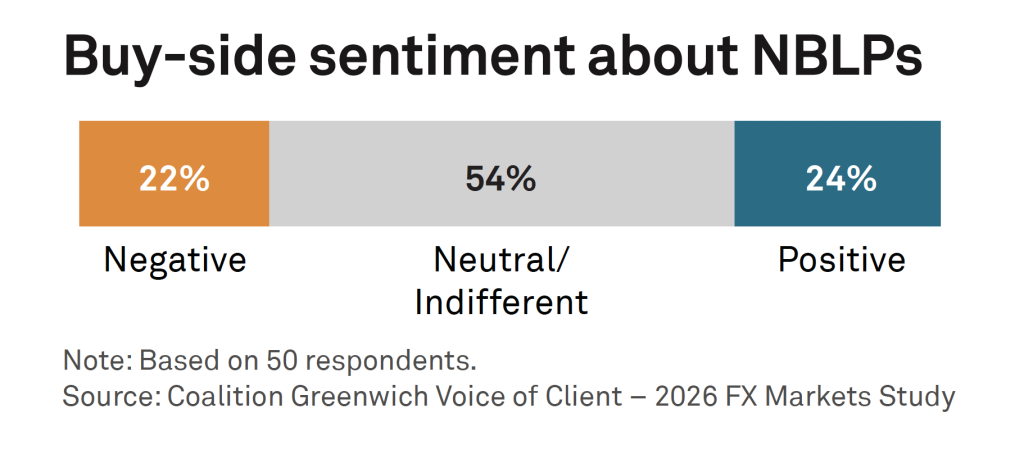
“NDF algos are still fairly nascent, there are algos available for them but adoption is not as high, they are mainly the realm of the multi-dealer platform,” Costabile says. “The list of algos that was mentioned, however, is very interesting, with a definite shift from TWAP and VWAP to using adaptive algos. That is a big change and an important one.” According to Costabile, a further surprising finding was that only 24% of participants were keen to use NBLPs, with other respondents feeling indifferent or negative towards them, despite the amount of hype about the markets growing reliance on NBLP platforms. However, one portfolio manager had pointed to the superiority of ‘better pricing models, pricing engines and risk management’ as key differentiators attracting more clients. In particular, respondents mention that some of the algo suites, such as XTX’s, have been ‘important in improving the search for liquidity and better automation’.
Looking ahead, Costabile predicts the direction of travel will be the ongoing focus on more automation. “That is not surprising and will result in continued algo use and more algo use, where possible and appropriate,” she adds. The study covered a number of key trends taking place in FX, but the overriding theme was that for most buyside professional ‘pricing is king’ – or at least most of the time. “Our study finds that best execution practices are driving counterparty and venue choices for participants,” says Costabile. “As a result, there has been more adoption of sophisticated algos to help navigate volatile markets.” While this is positive news, she notes that traditional dealer relationships remain strong in a price-driven, automated world for a number of reasons. “The human element of the bank-client relationship is intact and will likely remain one key determinant of counterparty choice for asset managers,” Costabile concludes. “Participants will continue to value superior execution, while also relying on trusted human experts as markets become more automated and complex.”
