


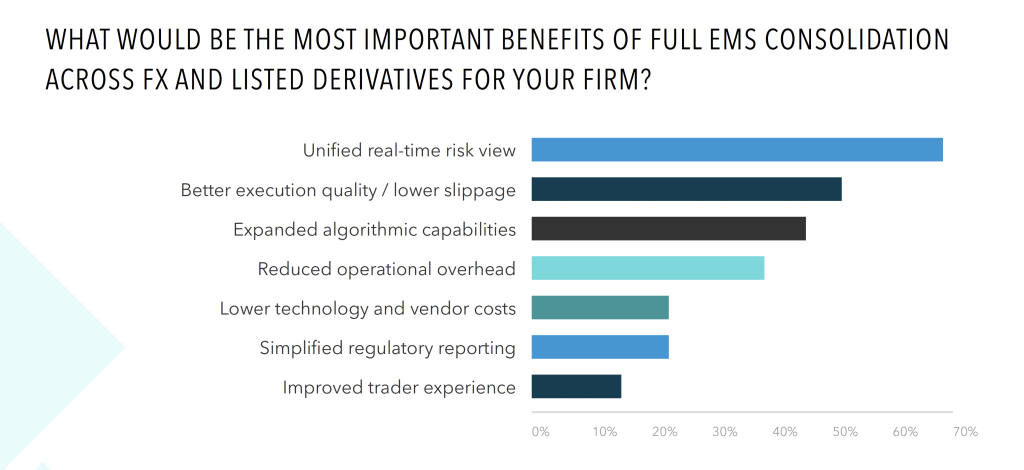
In a new survey looking at how buyside firms approach consolidating FX with other asset classes, particularly listed derivatives, expanded algo capabilities was cited by 46 per cent of respondents as one of the top three most important benefits that would be achieved from consolidating EMS platforms.
The findings are detailed in a new white paper, Bringing in FX: EMS Consolidation in a Complex Trading Environment, created by Acuiti on behalf of Trading Technologies International (TT). Based on a survey of hedge funds, proprietary trading firms and asset managers, expanded algo capabilities was the third most cited expected benefit from a system consolidation, after a real-time view of risk (69%) and improved execution quality (52%).
According to the study, a trading operation that is able to bring greater standardisation across systems also stands to improve algorithmic capabilities across the asset classes they trade, which the report adds is “an advantage for firms seeking to improve spreading tools for strategies like the basis trade”.
The research follows the recent expansion of the TT FX service, including the release of new functionality allowing traders to execute FX the way they trade futures using the same tools, screens and algo workflow, with bank algos now accessible from the same dropdown as futures algos.
Tomo Tokuyama, EVP, Managing Director, FX at TT, explains this addition of bank FX algos directly to TT FX has proven to be a significant selling point of the platform. “Multi-asset traders accessing bank execution algos for futures through TT can also access bank FX algos through the same platform and a consistent workflow,” he adds. “We are also seeing growing interest from clients looking to build their own FX algos, which they can do using TT’s ADL (Algo Design Lab) product.”
Tokuyama adds that while the findings of the study were not surprising, they reflected many of the conversations around the benefits of EMS consolidation while helping to address some of the perceptions which firms still hold around switching to a more cost-effective system.
He explains that client feedback to the expansion of TT FX has been positive, with clients noting that it makes sense for users of TT for futures and options to use the same workflows to launch their FX algos as well. “The real value is giving traders a consistent execution workflow across asset classes, reducing fragmentation while expanding what they can automate,” Tokuyama says.
