


Many banks today run successful internalisation models through central e-books but still rely on per-ticket hedging or static unwind rules when managing their exposure. In practice, that can lead to unnecessary market impact, sub-optimal execution costs, and higher P&L volatility, Nuti says. He adds: “When we started working on dbHedge, the core question we were asking ourselves was simple — how do we help banks manage centralised FX risk in a way that is as intelligent, adaptive, and data-driven as the execution strategies they now use to generate that risk in the first place?”
In response, dbHedge was built to offer clients a more effective alternative to the need for reactive, manual hedging. “By offering a more continuous and controlled approach, dbHedge allows clients to manage risk at the portfolio level, using the same sophistication they expect from modern FX algos,” Nuti says. This is achieved by enabling dbHedge to connect directly to a client’s central risk book via API, then working positions back towards defined targets using Deutsche Bank’s proprietary algorithmic execution stack.
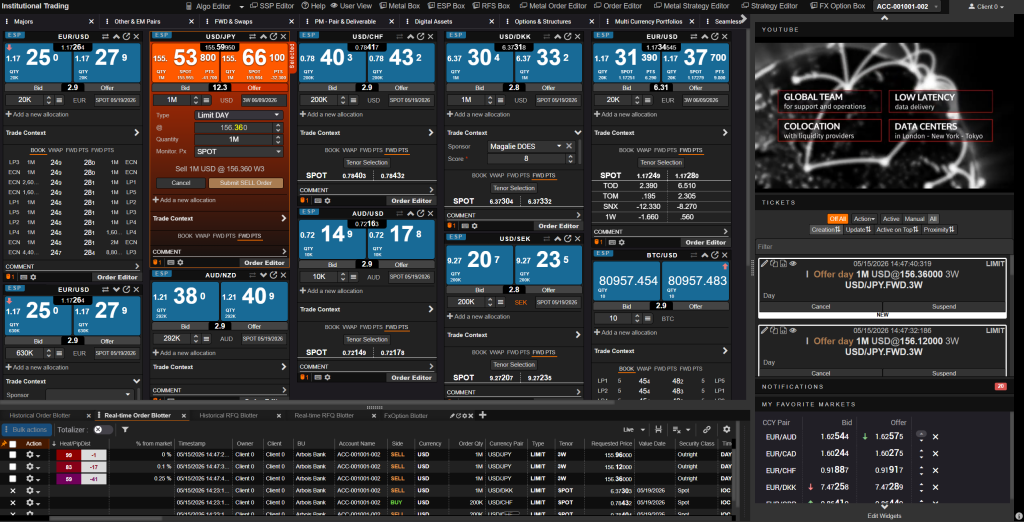
smartTrade integration
Clients can also define long and short bounds by currency, set time-of-day behaviours, and are able to dynamically adjust aggressiveness as positions approach their limits, Nuti adds. “Within those bounds, we work risk passively using Deutsche Bank’s franchise liquidity. Outside them, risk can be automatically externalised,” he says. As a result, he notes that real-time feedback is a critical component of dbHedge’s functionality, with every fill updating the risk position instantly, supported by end-of-day reporting and analytics. “This is not about handing control to an algorithm and walking away,” he adds. “Clients retain transparency at all times and can fine tune the framework to match their specific risk appetite and business model.”
A further key milestone for dbHedge is its recent integration into smartTrade Technologies’ LiquidityFX platform. “We chose smartTrade very deliberately,” says Nuti. “LiquidityFX is already the core pricing and aggregation engine for a significant number of regional and mid-tier banks globally. Integrating dbHedge as an optional execution route means clients can access our algo desk expertise without changing their existing workflow.” Through LiquidityFX, clients can now decide when to internalise risk, when to externalise via standard execution paths, and when to route positions to Deutsche Bank via dbHedge. “In essence, we are extending our algo desk into the client’s own environment,” Nuti adds. “This combination of technology and curated service is what makes the offering so powerful.”
dbHedge is also designed to solve many of the practical, day-to-day problems facing FX algo users. “It reduces P&L variance from open positions, controls execution cost versus speed, limits information leakage, and avoids unnecessary market impact,” Nuti says. “Crucially, it lets clients define the outcome they care about — whether that is cost, discretion, or speed — and consistently achieve it.” However, dbHedge is not simply another execution algorithm, Nuti adds. He explains: “What differentiates dbHedge is that it sits at the intersection of execution, risk, and service. It is an alpha-enabled hedging framework combined with direct access to Deutsche Bank’s liquidity and expertise.” Furthermore, every client engagement is tailored, with Deutsche Bank working alongside the client to identify the most appropriate strategies and parameters for their flow profile. “That curated element is critical,” says Nuti. “No two banks run their risk books the same way.”

to identify the most appropriate strategies and parameters for their flow profile.
Unique market proposition
Liquidity is another central pillar of the offering. By routing risk through dbHedge, clients are now able to gain access to Deutsche Bank’s global franchise liquidity across regions and time zones, Nuti adds. “Risk is worked intelligently internally before being shown more broadly, which improves netting opportunities and execution consistency, particularly in thinner liquidity conditions,” he says. Data and analytics further underpin every aspect of dbHedge. “Our alpha models balance adverse selection against opportunity cost in real time,” Nuti says. He adds that execution performance is also able to be continuously measured, with independent transaction cost analysis validating outcomes. “This feedback loop ensures the strategy adapts as market conditions evolve, rather than degrading as volumes scale,” he explains.
dbHedge became available to the market via smartTrade LiquidityFX in April 2026, following extensive internal testing and client engagement. Nuti says he believes the tool is particularly well suited to regional banks, market makers, and institutions that have successfully internalised flow and now need institutional-grade tools to manage the resulting risk. Looking ahead, he says that further enhancements are also in the pipeline. “We continue to invest heavily in analytics, scenario testing, and deeper integration across our FX algo suite,” Nuti concludes. “More broadly, dbHedge reflects where the FX algo market is heading — away from isolated execution tools and towards holistic, end-to-end risk and execution solutions.”
