

Internalisation is now very much an established feature of the FX algo market, yet buyside clients may often be unaware of the significant differences in how internalisation is currently being defined and applied by various algo providers. In a bid to increase transparency and best practise in the industry, the Foreign Exchange Professionals Association (FXPA) has published new guidance around the various flavours of internalisation and the implications these differences might have on algo execution.
The paper, FXPA Guidance: Definitions and Best Practices for FX Internalisation in Algo Execution, is the result of a collaborative effort which was led by Richard Turner, Senior Trader at Insight Investment and Chair of FXPA’s Buy Side Working Group, who led the development of the paper. “Internalisation plays a critical role in today’s FX landscape, but without clear definitions and standards, its application can raise concerns around transparency and execution quality,” he says “This guidance offers a practical framework that supports market integrity while enabling continued innovation and efficiency in FX trading.”
Insight Investment was a very early adopter of bank algos, Turner adds, but is also very aware of the risk of information leakage, making the internalisation offering from banks particularly appealing to the firm. “The caveat with internalisation is that there is no standard industry definition of what this involves. For one bank it may mean one thing, to another bank it may mean something else entirely,” he says. “Internalisation is great, per se, if it is literally me and another person shaking hands and moving on. But what we are increasingly noticing is that some types of internalisation can result in information leakage to the market. That is not internalisation in its true form, but not every user of FX algos is aware of the difference.”

Standardised definitions
While internalisation has emerged as a key mechanism by which liquidity providers manage risk and offer efficient execution, the paper notes that internalisation practices must be transparent and clearly defined to avoid issues of information leakage, market distortion, or execution bias. Turner explains that when looking at the TCA for algo executions, some counterparty banks do offer more transparency around the type of internalisation used, but not all offer this level of detail. “There is a question around the level of disclosure and transparency currently available to algo users,” he adds. “There is no one standard way of disclosing this level of detail, if it is disclosed at all. There are various reasons for this, often it is just something that clients may not be asking the banks for in the first place, but for buyside firms it is increasingly important to protect our clients’ interests, and we need this level of disclosure to help us with that.”
As a result, the guidance urges liquidity providers to disclose the venue or mechanism used to internalise trades. Specifically:
- Trade venue identification should be clearly labelled in post-trade reporting;
- If internalisation is used, clients must be informed as to whether this represents offsetting client algo flow or commercial LP activity; and
- Full timestamping and audit trails are recommended to ensure execution integrity.
Internalisation Type A – Client-to-Client Neutrality
The paper outlines two definitions of internalisation when used in algo execution: ‘client-to-client neutrality’ and ‘LP commercial flow offset’. Under the first model, client A’s algo order and client B’s algo order transact bilaterally via an LP and the LP acts as a non-influencing intermediary. According to the FXPA, the key principles under this model are:
- The LP does not use information from Client A or B’s trade to influence pricing or other market flows.
- Trades are executed under firm liquidity conditions, with disclosed full amounts, where possible, or through the life of the order (e.g. schedule algos).
- No use of ‘Last Look’ is applied.
- Pricing and execution are not skewed in anticipation of or response to market events.
According to the FXPA guidance, this model represents a “clean internalisation flow” and prioritises market neutrality, anonymity, and transparency.
Internalisation Type B – LP commercial flow offset
Under the second model of internalisation, LP commercial flow offset, client trades are offset against the LP’s commercial or risk management flows, which may include:
- The LP needing to trade opposite to a client due to a natural position existing within its market making desk or pre-existing commercial flow.
- Delta hedging or other derivative-related flows (e.g., options).
- Correlated product execution to manage portfolio or market exposure.
- The LP’s Principal stream is best price at time of execution.
- LP skewing prices to match with other client interest.
According to the guidance, the LP may skew prices in response to internal positions and algo interest but must “ensure such information is not leaked or used to influence client pricing beyond the bilateral transaction”. The paper notes that bilateral competition, for example in RFQ settings, should “not result in price deterioration or cross-venue information dissemination”.
In turn, the guidance outlines certain common fills that should not be labelled as internalisation, including matching client algo flow with another LP’s disclosed streaming price (whether skewed or unskewed) and mid-book fills, which refer to trade executions that occur at the midpoint between the bid and ask prices in an order book.
For voice trades, RFQ, RFS and algorithmic executions, the guidance goes on to recommend the following best practices to ensure execution quality and data integrity:
- Child order fills should be timestamped, with records maintained for audit and post-trade analysis.
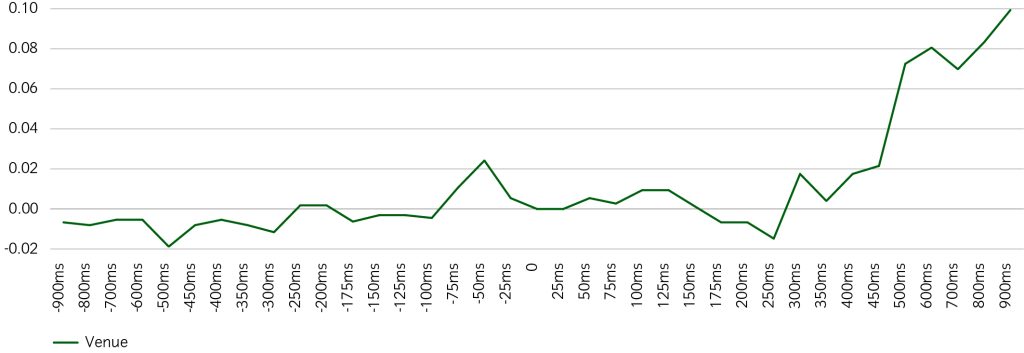
- Execution quality should be assessed using price decay or slippage analysis over the period of execution – for example, leakage or impact may be measured by comparing the arrival price vs. the volume-weighted average execution price over the trade window. See the graph above.
- Both user and L.P. can utilise data to improve execution outcome over time supporting the relationship model. All users should develop nuanced methodology to assess performance.
Improving market integrity
The guidance notes that both user and LP can utilise data to improve execution outcome over time supporting the relationship model, while all users should develop nuanced methodology to assess performance.
The paper outlines five key recommendations for the market as follows:
- Standardise Definitions: FX market participants should adopt the FXPA’s definitions of Internalisation A and B to promote clarity.
- Enhance Trade Disclosure: All liquidity providers must disclose internalisation practices to clients at or before execution.
- Implement Post-Trade Analysis: LPs and clients should collaborate on post-trade reviews, including slippage, latency, and information leakage assessments.
- Preserve Client Confidentiality: Skewed pricing or bilateral executions should not result in the dissemination of sensitive client order information.
- Support Auditability: Full timestamping and record-keeping of execution data should be implemented to enable independent verification and compliance review.
The guidance concludes that internalisation remains a powerful tool in FX markets when applied transparently and fairly. “By clearly distinguishing between types of internalised liquidity and enforcing robust execution practices, the industry can promote confidence, reduce information asymmetry, and align with the highest standards of market integrity,” the paper adds. “The FXPA encourages all market participants – liquidity providers, venues, and asset managers – to adopt these definitions and practices to foster a more efficient and transparent FX ecosystem.”
According to Turner, FX algo clients can also play a part by asking more questions about the type of internalisation being offered and to challenge algo providers to disclose more detail about how they offer internalisation. “When algo providers can show accurately what internalisation means for them, that is in itself is a strong franchise selling point,” he adds.
